
LEARNING PLAN/ Progress
Computer Vision and 3D Scenes
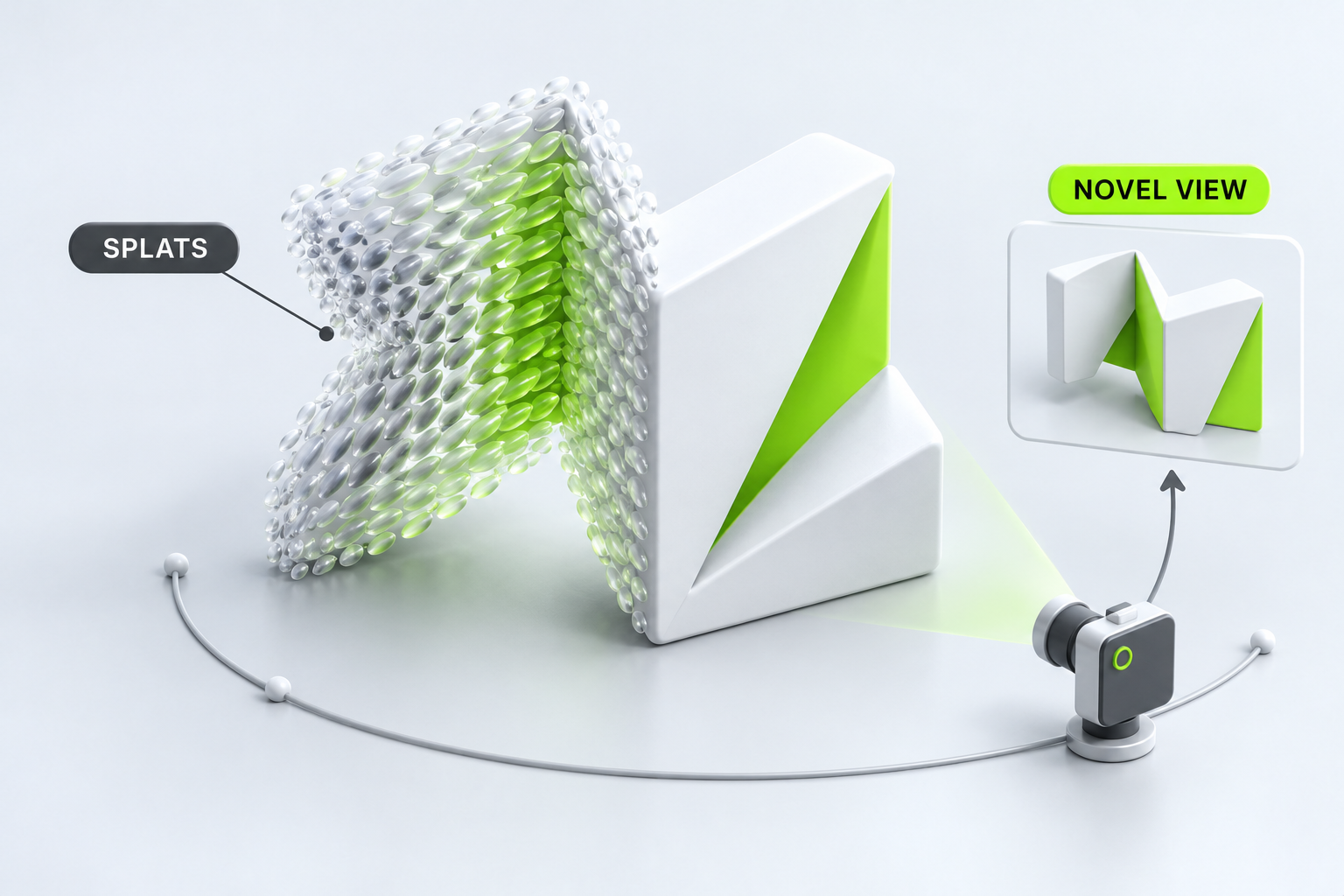
Extract observations automatically from real images, derive cameras, calibration, matching, and triangulation, then train a small Gaussian scene and render held-out views.
Start with a question, derive the mechanism, then test your implementation with new inputs.
Times are author estimates that include derivation and practice. They have not been measured with learners; work through the sections at your own pace.
WHAT YOU WILL BUILD
What will you build to demonstrate understanding?
- Observation from actual automatic PNG detection matching
- Estimated general camera and refuse degradation input
- Re-establishing the sensitivity of rice dot cloud and quantify depth
- Distinguishing cloud/grid/scene and visible models
- Real training is limited to the Gaussian scene and takes a perspective.
What should you know before starting?
- Base Python, array and vector operations
- Matrix Multiplication & Quantities
- Can run Python 3.11 and PyTorch projects
Use the prerequisites to choose a starting point. You can read freely and return to earlier lessons whenever you need them.
THE LEARNING ROUTE
A clear path, one step at a time.
Saved in this browser only. Marking a lesson complete does not mean the project has passed verification.
Observation and camera
Pixel extraction, projection and target estimation of cameras.
Image Files, Pixel Coordinates and Matchable Observations
How can a PNG become matchable observations without using the scene generator’s ground-truth 3D coordinates?
General Cameras, Rotation, Projection and Scale
How do rotation and translation project a world point into pixels, and what units do coordinates, focal length and scale use?
Estimate General Camera Matrices from Calibrated Images
Given 3D targets and pixel correspondences, how do we build DLT constraints and detect degenerate inputs that cannot determine a camera?
%1 should read
Check matching, triangulation uncertainty and visibility models.
Correspondences, Epipolar Constraints and Incorrect Matches
Why do similar colors and the epipolar constraint still fail to prove that two bright regions represent the same 3D point?
Triangulation, Depth Sensitivity and Geometric Refinement
How do two pixel observations determine a 3D position, and why can a small reprojection error coexist with unstable depth?
From Points to Fields: Representation, Visibility and Rendering
When the same points become a mesh, volume or Gaussian field, what assumptions do visibility and rendering add?
Combining and allowing for perspectives
Training of controlled Gaussian scenes to check geometry and light.
Train a Differentiable Gaussian Scene
How do pixel errors propagate to Gaussian positions, colors and radii, and which scenes remain unidentifiable by fitting?
Verify One Shared 3D Build and Report Its Failures
After reconstructing and rendering a new view, how do we jointly verify geometry, photometry, incorrect matches and ground-truth isolation?
BUILD / TEST / TRANSFER
From colored images to 3D luminous scenes
The five-view original PNG and the stand-alone non-combined targets are automatically tested, DLT, matching, triangulation and 84 parameters can be microGaussianized; new perspective predictions are retained, true errors should be matched with source receipts.
Runtime Requirements
Python 3.11+, PyTorch 2.6.0, NumPy 2.3.5, and Pillow 12.3.0. A CPU is sufficient.
Read the README after extracting the archive, then follow its environment and run instructions. Reference implementations and learning tasks are provided separately.
Project Checklist
This is a personal checklist, not an automatic grade. Keep your inputs, results, failures and reproduction commands.